

Many people struggle to wrap their heads around specific folklore that is entirely different from the cultural roots of their own country. It can be an arduous task for the ill-prepared minds that want to explore all facets of any country’s folklore that captures how its culture evolved from its roots to the present. There hasn’t been much anime that handled folklore with the level of atmosphere and creativity that the show Mushishi has to offer, and for this, we have to be thankful for its existence. A beautiful one, to be more specific.
How Mushishi develops itself from the ground up, in terms of its overall narrative, is by separating plot arcs into every episode with their own story that all feel unique and thought-provoking. The people, who Ginko comes across in these different episodes, are never seen again as he tries to make sense of how these “Mushi” behave and how they adapt to the landscape of Mushishi’s world by engrossing them in the people. What makes it extraordinarily admirable is the level of detail that encompasses the show’s entirety despite not having an over-arching “story.” Almost every character feels like actual people rather than one-dimensional caricatures that shows, like Mushishi, typically fall into when they try to do the same formula. I wouldn’t say that it’s as perfect as one would hope, but it’s more than enough for it to garner warm praise for its in-depth characterization. Ginko himself proves to be a competent leader by giving him the excellent detective mind akin to other great detective characters by giving him a solid back-story to his past life and how he came into being a Mushi-shi himself.
However, the absence of an overarching narrative in Mushishi doesn’t work since it is bounded by a slight disconnect of a tightly structured world that wants us to feel engrossed and connected. Still, it ultimately doesn’t come across as anything but average. While most of the episodes prove to be good in themselves, watching them all together and trying to encapsulate the very nature of the particular world they want to portray. It feels empty and shallow. It intends to make an episodic show, but at the same time, it tries to create this living, breathing society on a macro-level that doesn’t fit right on an episodic show. Its two properties of world-building don’t coincide perfectly. Mushishi comes across as far from perfect in this facet. The structure of Mushishi might’ve taken it took into a slight nose-dive, but there’s one exact detail to the show that makes up for it, the atmosphere.
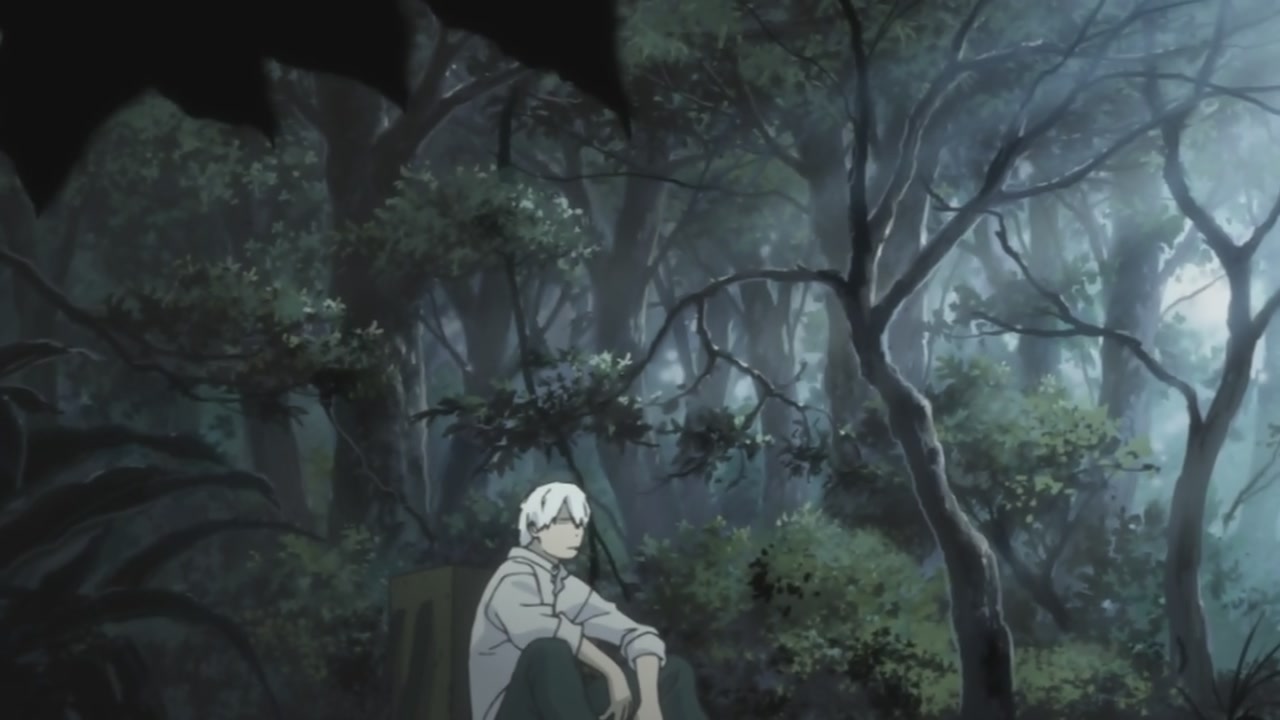
The atmosphere has to be just right for the viewer to be engrossed in it, and there’s plenty to go around in Mushishi. One other crucial detail that every person always mentions about Mushishi that comes from the gloomy atmosphere is that there’s not one person who finds the atmosphere nothing but beautiful. It’s hard to make an atmosphere that is faulty. Still, the one thing that would do a disservice to any show of Mushishi’s nature is how poor it creates a mood that is too blatantly lifeless or monotonous in integrating with the tone. To which I applaud Mushishi for bringing itself to its knees and flourishing. The lack of a lot of music helps to let us breathe in the atmosphere without any distraction for long periods while looking at the incredible artistry of the scene in question. I would’ve appreciated it even more if there was no music. The random musical instrumentation spread out at specific episodes doesn’t feel like the anime needed them.
With something as slow and methodical as shows like Mushishi, it manages to pace itself near-perfectly in letting us take in the scenes at face value without hinging on quick interludes that would hamper every scene. Despite its slow pacing, it never feels like a slog. It’s like listening to a great drone/ambient album that goes on for 2 hours, and once it’s done, you feel as though only mere minutes have passed because of how entranced you were from experience. That is one thing to describe Mushishi: Entrancing. Once you’ve set your sights and attention to the subtle details put into, not only the art but how hypnotic the writing of the dialogue is and the breathtaking Mushi sequences are, you can’t take your eyes off of it for one minute.
Great care is given to the tone of Mushishi as it builds up the mood at specific points to make it feel very compelling and robust on a mental and emotional level into the stories. The Mushi sequences alone are all extremely breathtaking to experience because of their lucid creativity and imagination that were put into practice by the brilliant artistry of the show. They’re the sequences that will forever be burrowed into your memory by the sheer awe-inspiring imagination inspired by Japanese folklore. These include the designs of the Mushis themselves and how the sequences themselves were directed brilliantly by how tense and uneasy they were portrayed whenever they appeared on-screen.

The artwork borrows heavily from influences of old Japanese artistry on an old Ukiyo-e print from early 17th Century Japan. It gives the atmosphere a bonus from the wonderfully detailed backgrounds and the creative animation of the sequences I mentioned beforehand. There’s not much in the way of overall breathtaking energy because of its plodding nature, but it doesn’t do a disservice since it fits very well to the tone. The character designs themselves look like actual human beings and have very minimal detail to the foreground of the palette on-screen.
Mushishi is a show that has to be seen to be believed, and you have to experience it for yourself to see the qualities come full force. It certainly did for me. Despite my thoughts on it not being perfect in how I view all of its positive aspects, that shouldn’t be a clear sign to not go through a genuine calming experience that you’ll hardly ever see in most anime. Watch it before you go to bed or anything that tries to make you reach a state of tranquility. It should prove worthy of any acclaim to people who’ve been interested in the pure Japanese mythology that this series has created for itself. If an anime show could rank along with “The Great Wave off Kanagawa” as one of the most significant contributions to Japanese art that showcases its aesthetic insight into its own culture, Mushishi would be that anime, bar none.
Grade: A-
 Gonzy's Anime Love Shack
Mmm, as you might expect, I’d have to disagree with your objection that “[t]he absence of an overarching narrative in Mushishi however doesn’t bold too well for it, since it is bounded by a slight disconnect of a tightly structured world that it wants us to feel engrossed and connected but it ultimately doesn’t come across as anything but average”. For one, it doesn’t aim to be very structured nor does it aim to offer much worldbuilding at all. Mushishi is essentially the mangaka’s perception of a feudal era Japan (the specific time period is unknown even to the author) bound with mystical elements. In all, the world is only a stage for Urushibara to portray simple but fundamental truths—like Kino if you will. They are not morals in Mushishi, but more about balancing one’s thoughts against whatever turmoils may occur in life.
(By the way your Mushishi link on your MAL profile doesn’t work.)
That could’ve strengthened it more had it made the structure of the world feel more alive rather than just a halfhearted attempt in doing so. The morals and inflections are fine, no doubt, but that doesn’t really excuse it any more than it needed to be. In fact, that’s one of the few negatives I had with Kino as well, but that didn’t stop me from calling that show great.